Yes, Genetics Matters To Your Body
Here’s a little secret the fitness industry won’t tell you: Genetics matters to your physique.
Once upon a time, I was in the fitness industry. I had a little sideline business as a personal trainer and nutrition/wellness coach. Here’s some truths:
It’s not hard to get a certificate as a personal trainer. Over a dozen years, I had 3 from different organizations. I’d let them lapse then decide I still wanted to be a trainer. So I’d take another course through a different organization to see what was different. I know and follow some amazing personal trainers but for every 1 smart trainer there’s about 5 bad ones.
Spend a few minutes on Instagram and you’ll see for yourself.
These are the trainers who eat ‘clean’ during the week but binge-drink on weekends. The ones who ignore medical research and peer-reviewed studies in favour of trending buzzwords like ‘Big Pharma’ and tell people that with enough daily steps, 3L of water a day, and meditation you can stop taking your prescribed medication. It’s just an excuse and a crutch anyway! They use bad weight-lifting form and teach it to others. They don’t realize or believe differences in skeleton make it necessary to alter the form for certain exercises for client SAFETY, instead they’ll coach clients to do what they’ve been taught is proper form and risk injury at worst, and slow their progress at best.
Also the type of trainer that will tell you that for 49.99 a month you can have the butt, abs, or waist of your dreams. However you want to make your body parts look, it’s absolutely possible but only with their program.
But here’s the thing:
Your genetics determine the ‘end point’ of what you can achieve naturally. You absolutely can improve things, work towards your best body, add muscle, lose fat…
But you can’t alter your genetics with diet and exercise.
Genetics determines your height and your skeletal physiology which determines your proportions.
If you want broader shoulders, you can add width by building bigger shoulder muscles but overall, the width of your shoulders is determined by the length of your collar bones. It’s determined by genetics. Genetics also determines how much muscle you’ll be able to add naturally in that area. You can get really close if you put the really hard work in for a very long time but genetics decides where the ceiling is for your potential.
Ads trying to sell you the easy and quick way to rid yourself of a FUPA or get flat abs use models with very long torsos. If the bottom of your rib cage is almost right on top of the top of your pelvis, you’re short-waisted. I don’t know of a single diet or exercise program that’s going to snatch a short waist, those of us who have them always look a bit boxier because of how short the torso is. By now, you know what determines that.
Genetics.
You can’t lengthen your muscles. Each muscle has an origin and an insertion point. The length between those two points is determined by your genetics. (You don’t tone them either, tone is controlled by your central nervous system. Usually when people say ‘toned’ they mean visible muscle definition.) If a fitfluencer says their program will tone and lengthen your muscles, they’re wrong.
There are bodybuilders who struggle with ‘lagging’ body parts. Maybe an absolute mountain of a man has smaller calves than he’d like. Let’s say he’s placed Top 10 in every bodybuilding competition he’s entered the last several years. You can’t say he’s not dedicated, that he doesn’t know how to train or eat, that he’s not motivated, that he hasn’t put the work in. He’s maybe reached his maximum calf growing potential as determined by his…
Genetics.
Here’s the thing. I’d never blame my genetics or use them as an excuse to give up on trying to improve my physique, my strength, or my functionality. “No point in working out because I’ll never have a six pack.” I don’t work out to improve my physique. My focus is strength and function but I know a lot of women hire coaches because they want thinner thighs, a bigger butt, a slimmer waist. There’s nothing wrong with those goals but your genetics will play a role in how much visible change you’re able to make without chemical or cosmetic help.
As a 46 year old woman, I don’t really care what my physique looks like. I just want to be strong and functional. There’s a sense of freedom with being ‘past my prime’ as a woman. I don’t need to try to make myself meet some stupid beauty standard that’s decided mostly by men. My body isn’t 25 years old and I don’t need it to look like it is. Performing like it was 25 would be amazing but that’s not a thing either. I think everyone wants to age well, but aging itself is inevitable. I’m about 85 in MS years but that’s another post for another day.
Genetics determines where your body prefers to store fat and for me, where I gain it first is the last place I lose it. I store body fat on my torso and my extremities stay pretty noodley. I don’t gain weight in my chest or glutes, sadly.
If I did I’d dirty bulk to gain ten pounds.
Can I change where my body prioritizes storing my fat? Not with diet and exercise, and it’s probably too late for gene editing.
Self-acceptance is a great side effect of getting older. I’m just more realistic about my body and changes I can make. My waist is short, my glutes will never be juicy, my belly is round because there’s about an inch and a half of space between the bottom of my rib cage and the top of my hip bones so I figure there’s no way my organs can be stored top to bottom; they must be side to side and front to back!
I’m the thinnest I’ve ever been and I weigh what I did in grade 11. That’s also how much I weighed when I stepped on stage for a bikini competition. Even at ‘peak’ thinness (for me), my waist is 32 inches. Genetically, I won’t ever look like I’d prefer unless I’m getting chemical help and maybe a little surgery.
I wish I could be ripped!
I’ve always wanted to be muscular, not in a bodybuilder way but in a very athletic looking way.
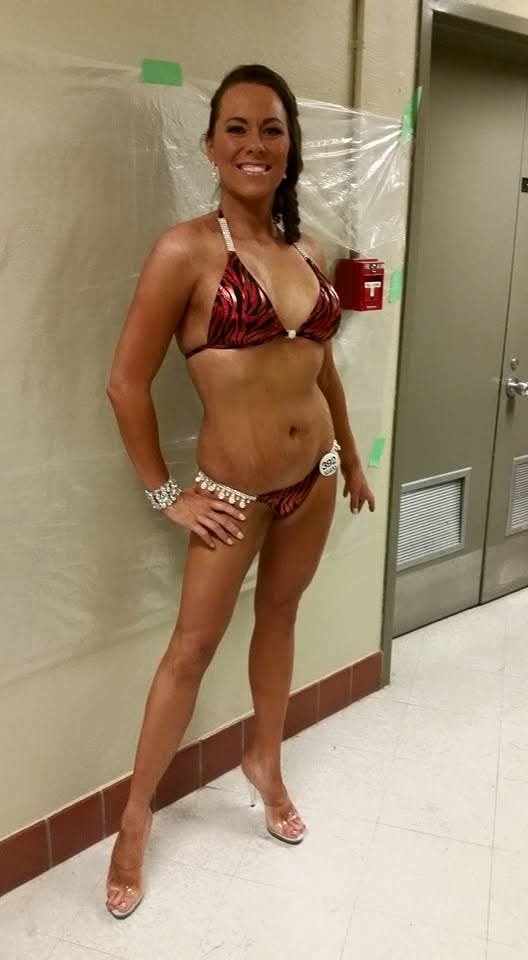
As you can see, even being on point with strict nutrition and 5 workouts a week for several months with a specialist coach didn’t add any of the muscle I wanted. I just got thinner which isn’t a goal I was ever really interested in. ‘Figure’ was where I wanted to compete but it was a natural comp(there’s testing for steroids, performance enhancers, etc.) and I love my coach for being honest: “You can’t compete in Figure naturally, the Bikini category is where your body type belongs.”
I share all this because it’s pretty rare a coach or trainer will be completely honest with you about your genetic limitations. Yes, dedication to training and nutrition can make huge differences to your physique. But many influencers sell this impossible dream that following their advice will get you the body you want. You can lose body fat and/or add some muscle (which is NOT a fast process) but if you’re 5’5 no amount of diet or exercise is going to make you look like a leggy 5’10. I’m thinner than I’d like to be right now and while my belly looks fine, there’s not a visible ab is sight. The amount of weight I’d have to further drop to see even a hint of visible abs would be very difficult, both physically and mentally and I’m not interested in doing it.
Fitness ‘experts’ are sometimes dishonest because they don’t want to risk the revenue, and sometimes because they don’t really understand biology.
If you just pay enough money to them long enough, miracles will happen! This is the same mindset that some have that if you’re determined enough you can cure your chronic illness. If determination and desire was enough, I’d still be dancing at competition level. I’d also have a 4 pack, a 30 inch waist, a JLo ass, and walk normally.
The best way, in my opinion, to make visible changes to your physique is overall strength building, which builds muscle. Muscle is what changes the look of your body but the takeaway is you need to accept genetics will decide about some things and it doesn’t matter how much money you pay a trainer, how dedicated you are, or how much work you put in. Fitness models have exceptional genetics and may be assisted in ways you might not be interested in. (No judgment of those who are) A lot of what you see online is fakery, grift, good lighting, good posing, maybe a little editing, and a filter or two.